v2.09 (4/05/10)

Copyright (C) 1999 by A. Yiannakis

THE SYSTEM OF WA SHIN RYU JUJUTSU


Video Clips Of Selected Wa Shin Ryu Jujutsu Techniques

Photos


  • Meaning of Wa Shin Ryu

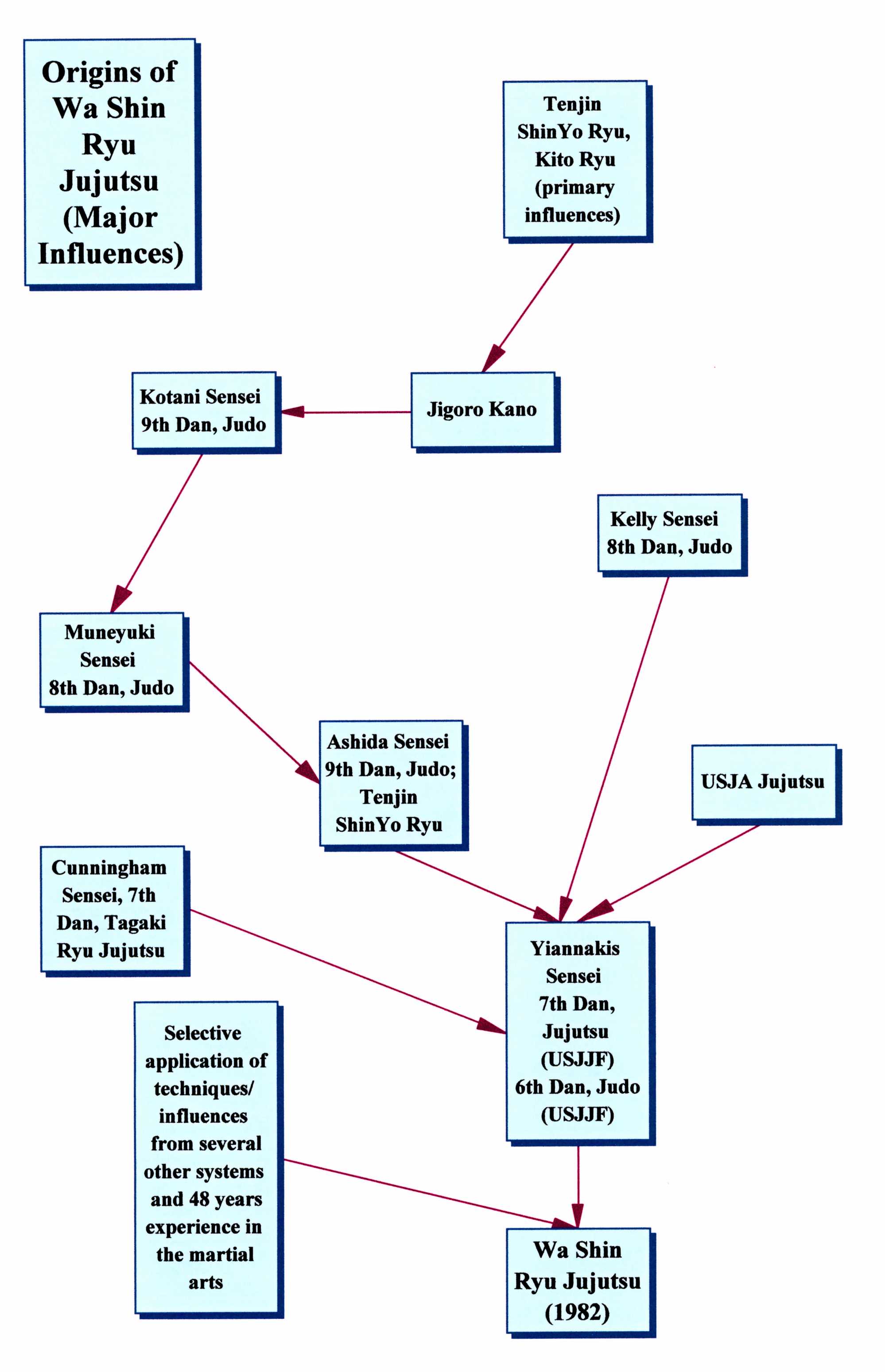
  • Founder's Lineage and Origins of System

  • Chart of Wa Shin Ryu Jujutsu System

    THE SYSTEM, PHILOSOPHY & PRINCIPLES
    of Wa Shin Ryu Jujutsu

    Sources of Power Generation In Wa Shin Ryu Jujutsu

  • What is an Uchideshi in Wa Shin Ryu?
  • Criteria for Awarding a Teaching License
  • The Meaning of Rank in Wa Shin Ryu Jujutsu

  • For black belts (especially Yodan and higher) rank in Wa Shin Ryu Jujutsu is an indicator that reflects accomplishment/development in FIVE key areas. These are:
      (i) Technical Expertise or the ability to demonstrate/execute technique at a level approriate to the rank in question

      (ii) Depth of Technical (technical principles and theory of technique execution) and Theoretical Knowledge (e.g., history, philosophy, etc.)

      (iii) Contributions to the Art through teaching, giving seminars/workshops, research, publications and presentations, service and club leadership

      (iv) Psychological Growth (Perfection of Character) and the Development of Ki Power as reflected in the degree to which the jujutsuka adheres to the Guiding Principles of the System, the development of inner strength, the ability to use multiple sources of power effectively (especially Ki Power), control, discipline, responsibility and maturity.

      (v) Candidate must be able to hold his/her own in kumite/randori against individuals of equivalent rank.

      It must be stressed that these are ideal goals that ALL in Wa Shin Ryu Jujutsu must work toward. Instructors will employ NO quantifiable standards or points for evaluating candidates for promotion but should collaborate with other high ranking instructors in the system to reach a "Professional Consensus" about whether a particular candidate merits promotion in accordance with the above ideals.

      Finally, no person in Wa Shin Ryu Jujutsu will receive promotion from any sanctioned instructor in the system if their level of Technical Expertise fails to match the rank level they are being tested for. However, while not minimizing the importance of Technical Expertise, after age 60 greater emphasis should be placed on Depth of Technical Knowledge, Contributions to the Art, Maturity and "Perfection of Character" and the development of multiple sources of power, especially Ki Power (see Sources of Power in "System, Philosophy and Principles").

      Promoting Mudansha

      The general criteria for promoting mudansha (non black belts) are as follows:

      (i) Student demostrates technique quality appropriate to the rank level they are being promoted to
      (ii) Demonstrates a positive attitude, is eager to learn, accepts criticism and cares for the safety of others
      (iii) Demonstrates commitment through regular attendance
      (iv) Student is able to hold his/her own in kumite/randori against students of equivalent rank
      (v) Demonstrates quality of movement appropriate to his/her rank level

  • The Wa Shin Ryu Tattoo
  • Application of Principles in Distance, Close Quarter and Ground Fighting

  • The Techniques of Wa Shin Ryu Jujutsu

  • The Beginner Syllabus

  • The Advanced Syllabus

    THE Formal KATA of Wa Shin Ryu Jujutsu

    The system has TWELVE formal kata and several Training Sequences and Experimental Kata. Their primary purpose is to demonstrate formal Wa Shin Ryu principles and their application in action. They are also a repository of many of the major techniques of the system.

  • 1. Ikkyo No Kata A: Kata for Distance Fighting - Tohma No Waza
  • 2. Ikkyo No Kata B: Attack (Kogeki) Combinations (Renraku) for Distance Fighting. 16 techniques

  • 3. Nikkyo No Kata A: Formal Kata for Close Quarter Fighting - Omote Version

  • 4. Nikkyo No Kata B: Close Quarter Fighting - Ura Combat Version
  • 5. Sankyo No Kata (Demonstrates Principles of Ground Fighting)
  • 6. Goshin Jutsu No Kata (Close Quarter Self Defense Kata. Formerly Mudansha No Kata). Demonstrates self defense applications in Zone 1 and 2 Close Quarter Fighting
  • 7. Russo Ashi Gatame No Kata (Includes photos of locks applied to knee and ankle)
  • 8. Buki No Kata (defense against weapons; 24 techniques ) Under construction
  • 9. Renraku No Kata (standing close quarter Zone 1 and 2 throwing combinations. 15 techniques)
  • 10. Ryoku No Kata (demonstrates selected principles of power and control; 21 techniques)
  • 11. Jigoku No Kata (Kata from Hell - Joint locking techniques applied to fingers, wrist and elbow). Partially completed
  • 12. Bokken No Kata (under development)

    Training Sequences/Experimental Kata

    These Training Sequences/Experimental Katas are here described as being executed on the right side (in most cases). However, they are to be practised on both sides.

    Rationale One of the major strengths of Wa Shin Ryu is its flexibility and ability to incorporare new techniques and strategies. That is, it has the ability to evolve as a system. To maintain this flexibility all black belt holders are encouraged to explore and develop new sequences, techniques and ways and introduce them to the system as Experimental Katas (formal sequences that demonstrate important principles and help fill "holes" in the system) or as Training Sequences. Training Sequences are less formal, they involve fewer techniques and one of their purpose is to help students develop transitioning skills in limited fighting situations/contexts. In this regard Training Sequences stress some of the more applied aspects of the system's Formal Katas. All new material introduced into the system must adhere to the System Principles and philosophy of Wa Shin Ryu Jujutsu.

    Sankyo No Waza (demonstrates selected principles of of ground fighting in a more realistic and interactive context). Tori begins with Oroshi Morote Ude Hineri and moves into a straddling position on the ground. Uke turns Tori over (bridge escape) and ends up in the guard as Tori. Strikes groin and with the right hand behind Uke's left knee turns him/her over and postions himself on top and behind Uke. Tori (formerly Uke) applies joint lock to small toe, then applies two ankle locks and finishes with a pressure point technique on Uke's left calf

    Nikkyo No Waza (forms of Clinch Throwing without a gi) (demonstrates selected principles of close quarter throwing techniques from the standing position in a more realistic and interactive manner). Techniques executed from the clinch position (often without a gi) include modifed forms of sasae tsurikomi ashi, osotogari, sumi gaeshi, ouchi-gari, ko-uchi gari, yoko wakari, kosoto-gari, tani-otoshi, uki goshi, harai goshi (circular), ogoshi and okuri ashi barai (circular) among others. Typically Tori will then follow through to the ground and apply a variety of finishing techniques.

    The Gregorian Sequence (links close quarter and ground finding strikes and joint locking techniques. Tori begins with fake uraken to face which then becomes a strike to the arm pit, followed by neck twist to ground, kote gatame, turnover into hadaka jime)

    Russo No Waza (strikes, blocks, deflections, evasions and kicks - 9 techniques. Uke delivers oblique strike to temple, then punch to stomach, etc )

    Tiger Walks the Elephant (for timing, control, coordination and harmonizing)

    Kirby-Stanley Katame No Waza (knife deflection to single leg take-down into kesa gatame, escape into kote gatame, etc.)

    Uki Goshi No Waza. #1 attacks with downward blow to head. #2 enters with Uki Goshi (floating hip), throws and secures kesa gatame. #1 escapes and holds #2 in kesa gatame. #2 escapes by turning sideways but #1 traps defender's right elbow with own right elbow. #2 rolls to front, face down and covers up. #1 grasps defender's right wrist with own right hand and while pressing defender's base of neck to floor (with left hand) steps over, pins defender's upper arm on the tricep muscle with own right forearm (sharp edge of own forearm) and draws out and straightens defender's right arm ending up in modified (kuzure) Waki Gatame (side lock). When defender submits attacker secures defender's other arm (elbow to elbow) and brings both hands together, sitting back on defender's shoulder and side of head. The subject is thus pinned by defender's effective use of center and secure hold of both of attacker's arms.

    Handgun Disarming Techniques (30 techniques, in progress)

    Strategic Responses to Jodan, Chudan and Gedan Forms of Attack

    Levels of Training Engagement

    Training by Principle in Wa Shin Ryu Jujutsu

    Requirements for Promotion and Fees

    Health/Hygiene Practices (required)

    Dojo Etiquette (required)

  • Special Readings For Promotion

    Time in Rank/Promotion Schedule

  • Acceptable Attire and Training Equipment

  • Forfeiting of Rank


    Wa Shin Ryu Jujutsu is recognized by and registered with the USJJF and the USJA